
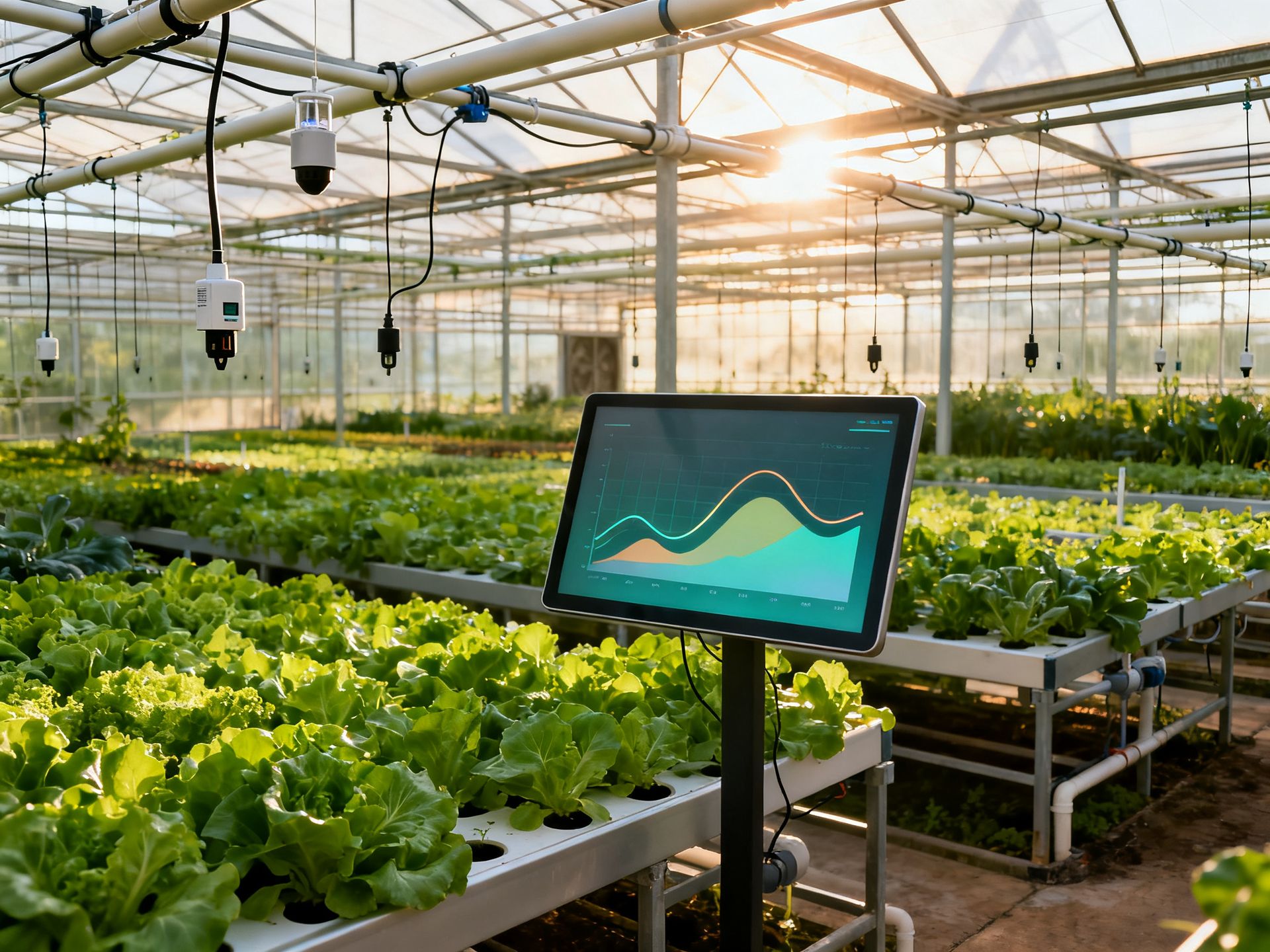
Smart Greenhouse Control
Smart greenhouse control: linked temperature, humidity, light and CO2 regulation with mobile remote monitoring, automated irrigation and venting.
Project Background and Client Needs
A modern agricultural park of over 300 mu grows tomatoes, strawberries and other high-value crops across 60 connected greenhouses. Environmental control relied on veteran farmers: manual venting by day, patrol rounds at night — one lapse could cost a whole greenhouse's yield — while irrigation ran on a fixed schedule regardless of actual crop needs, wasting water and fertilizer. The park wanted a smart control solution that would shift environment and irrigation management from experience-driven to data-driven.
Smart Greenhouse Control System Overview
JuHui Software built an integrated software-hardware-cloud smart greenhouse control system: each greenhouse carries temperature/humidity, light, CO2 and soil-moisture sensors, with control cabinets driving fans, curtain motors, grow lights and irrigation valves. Growers monitor real-time conditions, receive alerts and intervene remotely through a mini-program and app, while the cloud console manages devices in a park–plot–greenhouse hierarchy with crop models and linked strategies. Edge controllers keep regulation running even on weak rural networks.
Core Feature Modules
- Real-time environmental monitoring: around-the-clock sensing of temperature, humidity, light, CO2 and soil moisture, with side-by-side greenhouse comparison.
- Automated linked control: target ranges follow crop growth models, auto-driving fans, curtains, grow lights and irrigation valves without staff on duty.
- Instant anomaly alerts: high/low temperature, sensor offline and equipment faults push to managers' phones within seconds.
- Mobile remote management: remotely switch devices or adjust strategies from the mini-program, keeping greenhouses tended while traveling.
- Integrated water-fertilizer irrigation: irrigation and fertilization run automatically on soil moisture and growth stage, precise to each greenhouse and valve.
- Crop records and reports: environmental data, farming operations and yields archived per cycle, building a reusable knowledge base.
Technical Architecture Highlights
With field wiring difficult across a large park, the sensing layer mixes LoRa and RS485: battery-powered soil sensors report over LoRa, while fans and curtain motors connect to edge controllers via RS485 cabinets. Each edge controller embeds a strategy engine that keeps temperature logic executing offline; devices exchange data and commands with the cloud over MQTT, with 4G gateways as redundant links. The cloud stores environmental streams in a time-series database, and the crop model library configures target parameters flexibly by variety and season.
Launch Results and Data
Covering all 60 greenhouses, the system put temperature, humidity and light under full data management, with fans, curtains and irrigation automatically linked — night-shift staffing dropped by more than half. Late-night temperature alerts repeatedly woke duty staff in time to avert whole-greenhouse losses. Need-based irrigation replaced the fixed schedule and cut water use by roughly 30% while fertilizer efficiency improved; accumulated crop records helped agronomists refine lighting and ventilation strategies, lifting first-season tomato marketable-fruit rates noticeably over the previous cycle.