
Smart Home Control System
Smart home control system: one app and wall panel for lighting, curtains, security and scene automation, with remote monitoring and voice control.
Project Background and Client Needs
A smart home brand targeting the mid-to-high-end European and American markets planned a product-line upgrade. Its legacy setup forced users to juggle separate apps for lighting, curtains and security, scene automation required manual setup, and after-sales had no unified device console. The client wanted an end-to-end IoT partner — hardware, software and cloud — to consolidate the whole home into one system that also met Western privacy rules and voice-ecosystem requirements. With a decade of IoT custom development experience, JuHui Software took on the project.
Smart Home Control System Overview
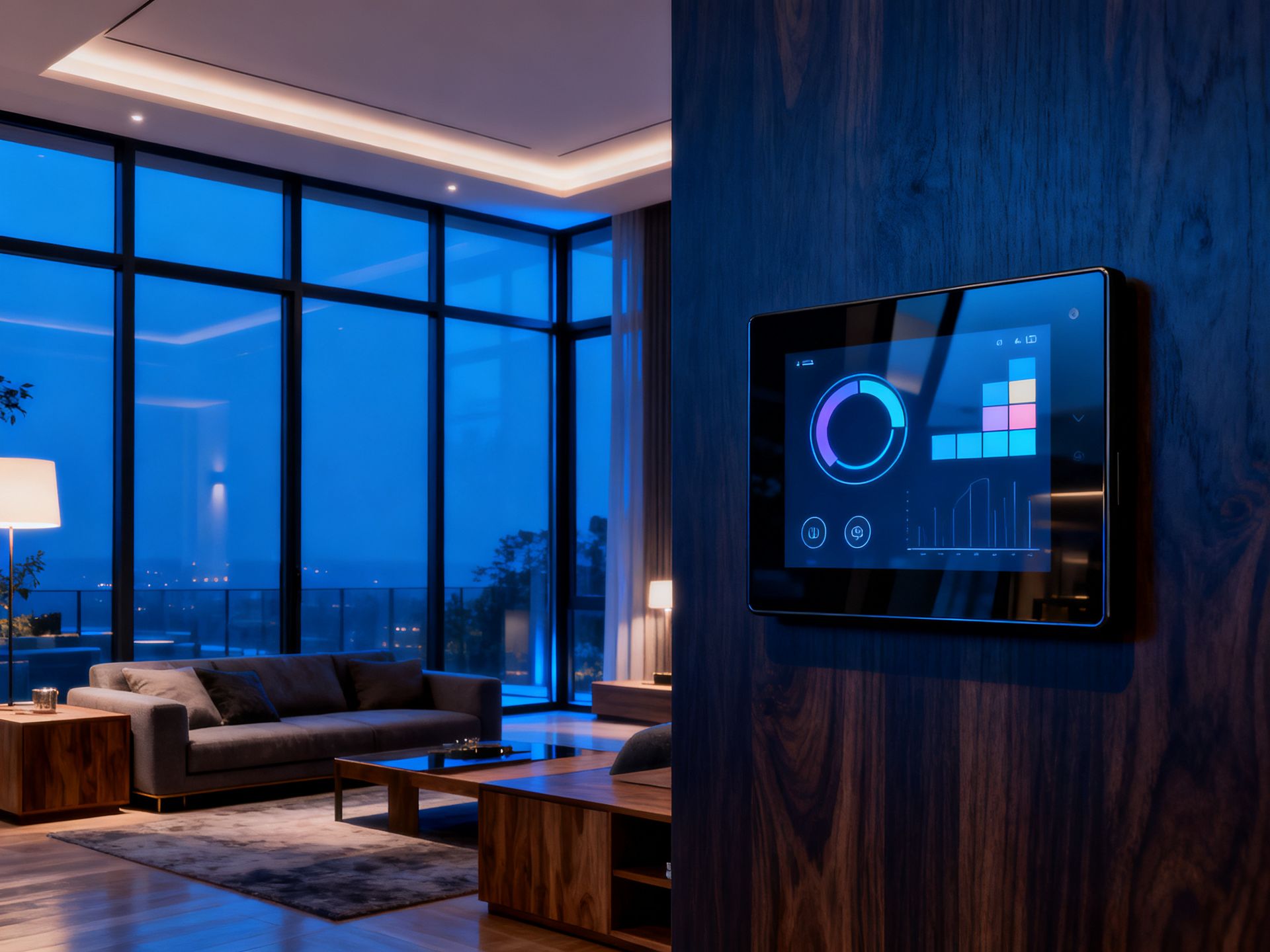
We delivered a whole-home smart home control system built on four cooperating layers: an app and mini-program for daily control and scene management; wall-mounted control panels providing offline-capable local control; a cloud console for the brand to manage devices, firmware OTA and user operations; and in-home gateways connecting lights, curtains, HVAC and security sensors. A single household hosts 200+ devices, with customizable grouping and permissions.
Core Feature Modules
- Unified whole-home control: switch, adjust and monitor lights, curtains, HVAC and security in one app.
- One-tap scene automation: preset Home, Away, Movie and Sleep templates, fully customizable, triggering multi-device actions at once.
- Schedules and conditional automation: run by time, geofence or sensor thresholds — lights on at sunset, arming when leaving.
- Remote monitoring and alerts: live device status and camera views anywhere, with instant push alerts for doors or smoke.
- Voice ecosystem integration: deep Alexa and Google Assistant integration for hands-free control of the whole home.
- Firmware OTA and after-sales tools: batch upgrades, remote diagnostics and ticket dispatch to cut service costs.
Technical Architecture Highlights
The device layer uses dual-mode Zigbee 3.0 and Wi-Fi gateways: Zigbee meshes low-power sensors, Wi-Fi carries high-bandwidth devices. Gateways exchange telemetry and commands with the cloud over encrypted MQTT, and critical scenes execute at the edge — panels keep basic control working offline. A device-shadow model keeps commands reliable on weak networks; all links are TLS-encrypted to meet GDPR and CCPA, with voice connected through officially certified Alexa and Google Assistant interfaces.
Launch Results and Data
Launching first in North America and Western Europe, the system covered several thousand households in its initial rollout. A single home reliably hosts 200+ devices with one-tap scenes executing in seconds; after Alexa and Google Assistant integration, voice became one of the most-used interaction modes, and app store ratings clearly surpassed the legacy solution. Using the unified console for OTA and remote diagnostics, the brand saw on-site service tickets drop markedly, laying the groundwork for new product categories.