
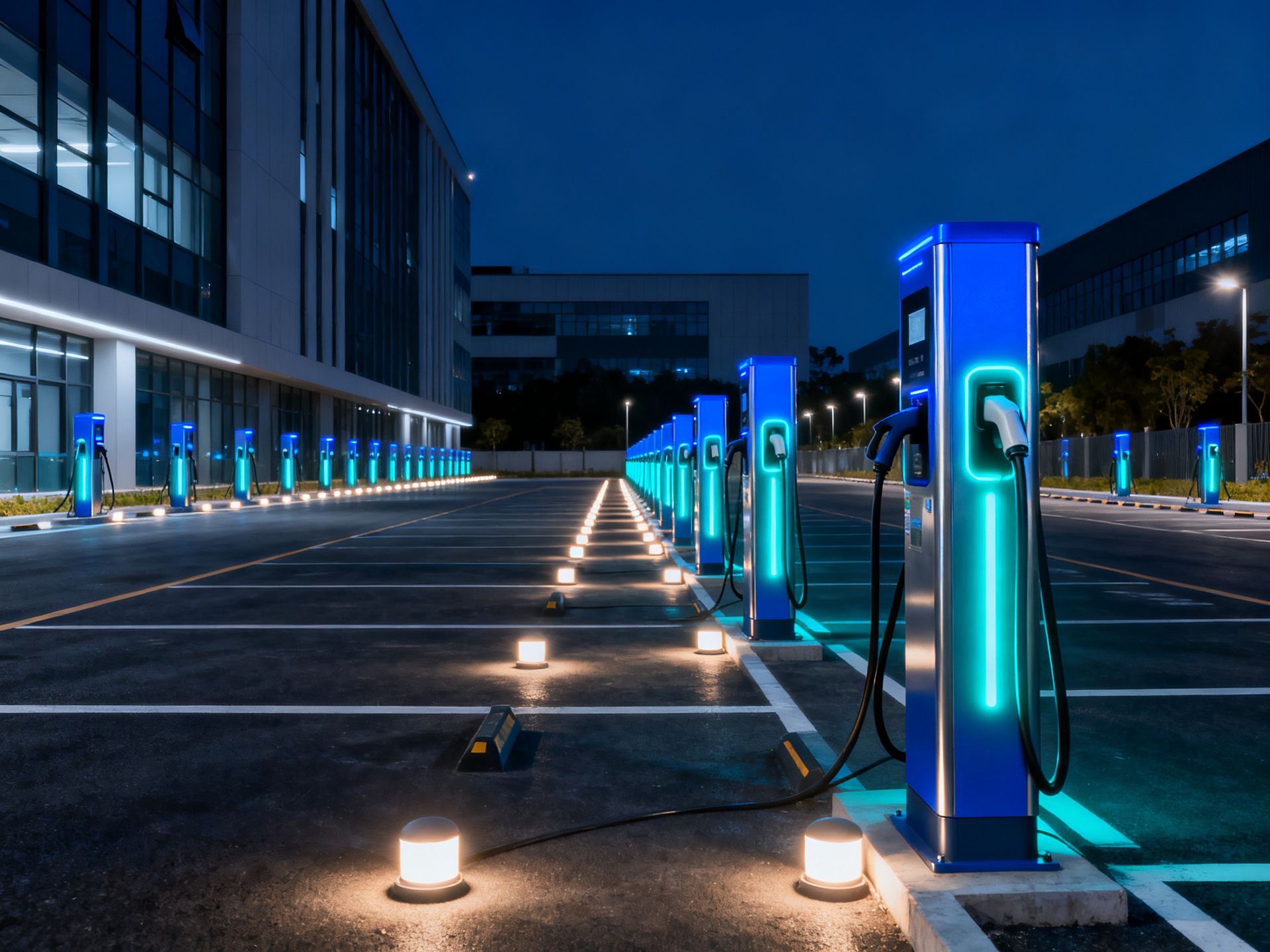
Campus Charging Network System
Campus charging network management with space linkage, load scheduling and guest charging. (Demo data)
Campus EV Charging Management System: Background & Client Needs
Industrial parks concentrate EV commuting, yet campus charging is plagued by ICE-vehicle squatting on charging spots, limited transformer capacity, and ambiguity over how to settle visitor charging. The operator of a large industrial park planned a campus-wide charging network and required the system to solve three problems: parking-resource scheduling, load management and multi-party settlement. Juhui Software delivered this campus charging management system as a custom build.
Solution Overview: A Smart Charging System for Industrial Parks
This EV charging management system covers all campus charging scenarios across four ends: a driver mini-program (reservation, charging, payment), the charger and ground-lock device end, a park operations console (space linkage, load scheduling and settlement), and a payment-and-settlement layer. The system integrates with campus barriers, linking charging spaces with access control to keep ICE vehicles out.
Core Feature Modules
- Barrier linkage for charging spaces: charging spots connect to the barrier system, detecting ICE squatting and prompting relocation to keep spaces charger-only.
- Dynamic load scheduling: real-time transformer monitoring dynamically adjusts each charger's output to avoid overload trips.
- Guest temporary charging: visitors scan and charge with time-based billing, settled separately from employee channels.
- Per-tenant settlement: employees' charging costs attribute automatically to their company's account with monthly consolidated invoicing.
- Campus-wide charging dashboard: utilization, energy and revenue visualized by zone and time slot to guide expansion decisions.
Technical Architecture Highlights
Chargers connect to the cloud over 4G via MQTT, reporting power, load and space status. The load-scheduling engine treats transformer capacity as a hard constraint, allocating charging power by priority to balance speed against electrical safety. Space detection combines geomagnetic and license-plate data, linked through the barrier interface. The mini-program integrates WeChat Pay, running guest pay-per-session and per-tenant monthly settlement in parallel with automatic splitting and clearing.
Results & Data After Launch
After launch, barrier linkage made charging spaces genuinely charger-only — ICE-squatting complaints dropped to nearly zero. Dynamic load scheduling let the park support more charging points without transformer upgrades, with no more peak-hour blackouts. Settlement granularity down to individual companies made every tenant's charging costs clearly traceable, and monthly consolidated settlement greatly simplified finance workflows. The campus-wide charging dashboard provided the data basis for phase-two expansion, as charger utilization and the share of EV commuting in the park continued to climb.